Building and deploying a bilingual MES that connected a changing NPI operation with a mass-production floor in another country.
My roleSenior Manager, Advanced Manufacturing EngineeringFocusManufacturing systems · deployment · adoption
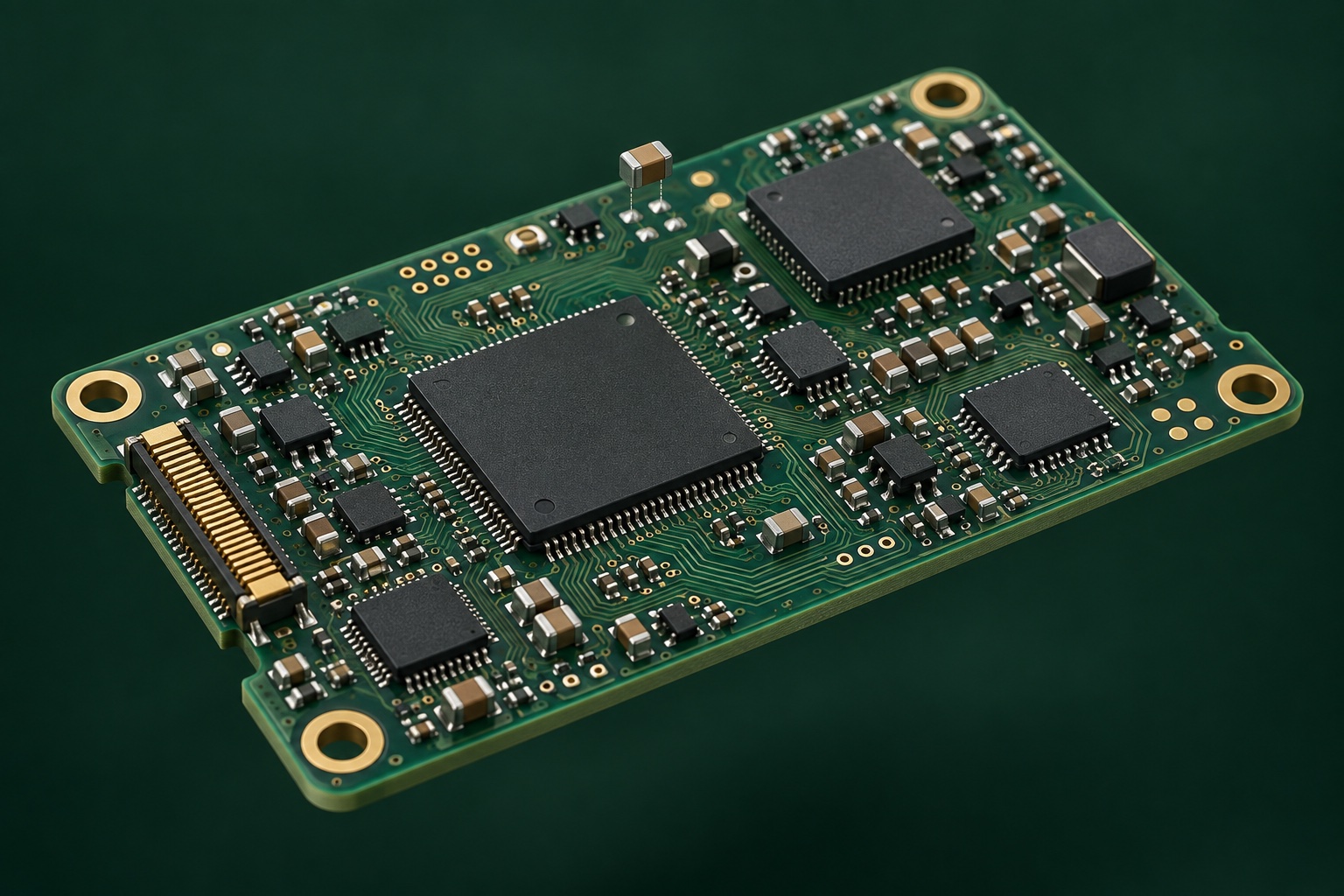
Concept illustration of a PCBA; not a factory system screenshot.
2Production plants · US and Mexico
EN / ESBilingual operator experience
1Shared production database
01 / THE CHALLENGE
Different rhythms. The same need for traceability.
The operation combined new-product introduction in Texas with mass production in Mexico. Spreadsheets, shared drives, and informal handoffs connected the two floors, while the NPI process continued to change.
I built the business case for an in-house MES and led its delivery across both plants, working with Engineering, Operations, Quality, IT, and Supply Chain. The leadership challenge included deciding what to own, earning operator adoption, and releasing changes without disrupting the other plant.
02 / THE DECISIONS
Own the system that holds the process.
Build a system the manufacturing team could change+
The tradeoffThe commercial options we evaluated involved license and integration costs, with a change-request process between our engineers and process improvements.
My responseBuilt the business case for developing the MES in-house, secured approval, and owned scope, schedule, and delivery with the cross-functional team.
What supported the decisionThe NPI line changed weekly, and process-system changes could deploy in days.
Treat bilingual readiness as a launch gate+
The tradeoffA shared system still has to work for operators on both floors. Language support could not be deferred until after launch.
My responseReleased English and Spanish screens together, enforced through the release process.
What supported the decisionThe system served both production plants with the same workflow coverage and a shared database.
Release while the other factory is running+
The tradeoffTwo live sites on one database make deployment a manufacturing-continuity problem as well as a software task.
My responseUsed backward-compatible schema changes and retained historical records when retiring inputs.
What supported the decisionExisting production records remained readable while the system evolved.
03 / THE OPERATING SYSTEM
Follow the unit through the factory.
The system covered the production flow, from work orders through execution and genealogy. Explore the operating responsibilities below; this is a conceptual view of the system’s scope, not a screenshot of proprietary software.
US productionONE SHARED MANUFACTURING RECORDMexico production
↳ Controlled changes return to station execution.
ERP
Production intent meets execution.
Production orders and line release connect to ERP. Completions and inventory updates connect the production record back to the business system.
INFORMATION FLOW
Order → MES → completion / inventory
EVIDENCE
Order identity and release context
Station execution
Put the right work at the station.
English and Spanish execution, controlled documents, and labels support operators at both plants. Bilingual readiness was treated as a launch gate.
INFORMATION FLOW
Released order → operator workflow
EVIDENCE
Unit, station, and process context
Measurement capture
Give a measurement its context.
Measurements from test, inspection, and process equipment are tagged with part, station, and recipe so they can support traceability and investigation.
INFORMATION FLOW
Equipment → contextual production record
EVIDENCE
Measurement + part + station + recipe
Shared MES record
Keep the unit’s history connected.
Serial genealogy and timestamped production and quality records connect the two plants. Historical records remain readable as the system evolves.
INFORMATION FLOW
Execution + measurements → genealogy
EVIDENCE
Unit history across production and quality
Quality & SPC
Turn the signal into a decision.
SPC reaction plans and quality records support investigation and response. A signal initiates engineering action; this diagram does not imply automatic process adjustment.
INFORMATION FLOW
Production record → investigation → response
EVIDENCE
Signal, evidence, and investigation context
Controlled change
Carry the learning back to the floor.
Findings inform process improvements. Controlled documents, bilingual releases, and backward-compatible data changes support continued operation at both plants.
INFORMATION FLOW
Engineering decision → controlled station release
EVIDENCE
Updated method and retained historical evidence
Conceptual information flow based on the case study; not a network topology, live integration, or proprietary system screen.
Adoption came station by station: replacing disliked paperwork and letting operators see their own data before asking them to trust more automation.
04 / THE IMPACT
Make the manufacturing record usable.
Before
Reconstruct the answer
Quality investigations depended on finding and connecting spreadsheets, shared files, and local knowledge.
After
Query the unit’s history
Serial genealogy linked production and quality records across both plants, with timestamped evidence for customer and audit questions.
The result was a production system running across two plants, with bilingual execution, ERP integration, direct measurement capture, and traceable unit histories. Process changes could deploy in days.